
Last April we were fortunate to spend five days exploring Burgundy with the Wine Scholars Guild, alongside a group of serious wine enthusiasts and experts.
For us, as winegrowers in Oregon, visiting the spiritual home of Pinot Noir and Chardonnay was both inspiring and eye-opening. Our biggest surprise was how little of the conversation about Burgundy's greatness seemed to center on farming practices.
With notable exceptions, Burgundy is above all about the primacy of place. Across much of the region, clay soils and fractured limestone help regulate water availability and encourage deep rooting, supporting gradual ripening and a balance of sugar, acidity, and phenolic maturity. Beginning in the 12th century, Cistercian monks began documenting the relationship between vineyard site characteristics and wine quality. Centuries of observation and refinement laid the groundwork for Burgundy’s intricate hierarchy of Grand Cru, Premier Cru, and Village appellations known today.
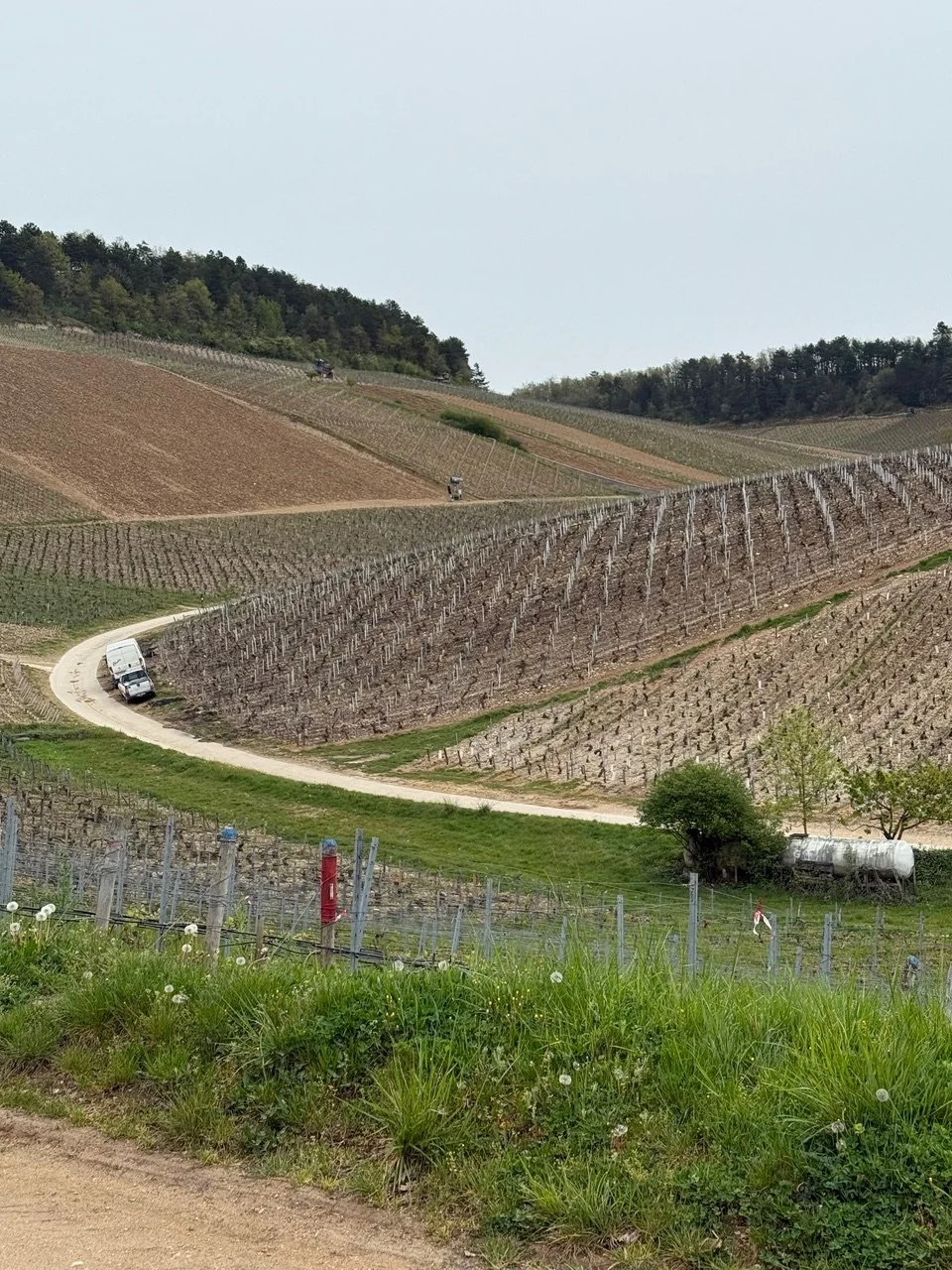
One striking feature of Burgundy is its extraordinarily dense planting, approximately 3x the number of vines per acre compared to most other places including the Willamette Valley. Interestingly, the yield of grape tons per acre in Burgundy is similar to other high quality wine regions, approximately 2-3 tons per acre. The explanation for the similar yield per acre despite so many more vines is simply that the plants are kept smaller with fewer fruit clusters per plant. That does not mean there is more flavor concentration in the smaller number of clusters, it simply means that there is less canopy, less photosynthetic capacity available, resulting in a smaller number of clusters per vine. The rationale for this system is a relic of Burgundy’s long history, but if there is a present day quality rationale it may be argued that it is easier to achieve uniform vine balance and controlled canopy size with smaller plants.
Walking through Burgundy, we were struck by how many vineyards had remarkably little vegetation beyond the vines themselves. Aside from the vines, the ground was typically clean with few weeds or covercrop visible. Indeed there is not much room for other vegetation since the vines have enough competition from each other due to being planted so densely. To keep the soil bare and free of competing plant life, tillage and herbicide is used extensively.
There is general talk of a preference for organic methods, but given commercial realities amidst climate volatility, the common farming practice pursued is referred to as lutte raisonnée. Lutte raisonnée, or “reasoned struggle” is a French approach to viticulture that seeks to minimize chemical treatments – including herbicides, fungicides, and insecticides – through careful monitoring and targeted intervention as needed, rather than routine spraying. But in practice there is a fair amount of chemical intervention happening. Le Monde reported in March that vineyards holding organic certification or undergoing organic transition is expected to peak out and expand no further than 23-25% of Burgundy vineyards.
Burgundy exemplifies the fragility and input-intensive uphill struggle against nature that is intensive monocrop viticulture in an era of climate volatility. 2026 is in the running to be the hottest year on record in Burgundy – surpassing the famous hot 2003 vintage – with a very early bud break in March followed by the worst case scenario of April frost, punctuated thereafter by hailstorms, fires, and late season rainfall. In Oregon we were lucky to have a very mild summer but our turn for climate adversity will no doubt arrive in the seasons to come.
But what about the wine in Burgundy? Well, it is still pretty amazing of course! We will likely never forget tasting (er, drinking, no spitting this one) the Échezeaux Grand Cru from Domaine Jean Grivot in Vosne-Romanée and listening to 6th generation winemaker Mathilde Grivot explain the methods she used to overcome the late season heat spike in 2023 to create a wine with such extraordinary vibrancy and tension.
Towards the end of our Burgundy visit we found a very encouraging sign that Burgundy’s farming practices are evolving, in the form of a visit to La Soufrandière in the Mâconnais and spending a few hours with its winemaker and viticulturist Jean-Philippe Bret. La Soufrandière has been certified organic and biodynamic since 2006, and we received an inspiring tour of their biodiverse vineyard from Jean-Philippe who seems destined to be a rockstar of sustainable organic viticulture if he is not already. And their wines are outstanding and worth seeking out. It was an especially fitting way to conclude our visit.
Burgundy's extraordinary wines have long demonstrated the importance of place. What excites us at Acania is the possibility of taking that insight further: that the living ecology of a place, not just its underlying geology and climate, may also be fundamental to the quality and character of the grapes it produces. That's the question we're exploring through our vineyards, Vitiforest, and soil research. And it is one we returned from Burgundy even more motivated to pursue.