
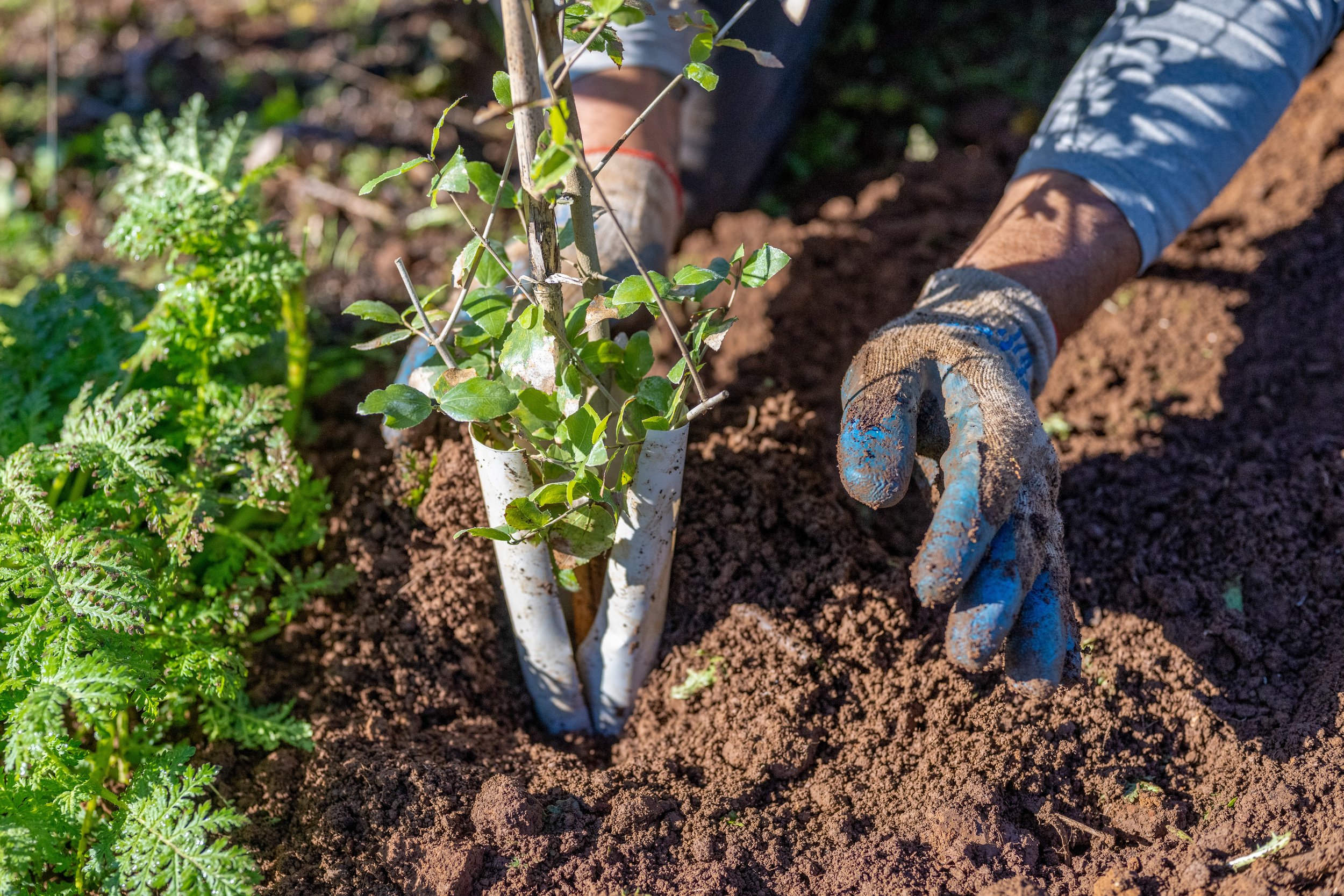
Acania Vitiforest Part II:
Soil Biology, Measurement, and What Emerges
Beneath the surface is where the deeper questions of the Vitiforest reside.
So much of farming happens invisibly. The chemistry of root exudates. The microbial guilds that cycle nutrients. The structure of soil that holds air and water and makes resilience possible. The trading networks of mycorrhizal fungi that connect plants below ground, extending root systems into a shared biological infrastructure.
Grapevines are unusually adept at forming these symbiotic relationships. Through mycorrhizal networks, vines can access nutrients and water beyond the reach of their own roots, buffering stress and participating in a much larger ecology than is visible from the surface. In diverse, living soils, these networks flourish. In simplified systems, they often diminish.
This is one of the underlying motivations of the Vitiforest. Diverse plant communities may support different biological patterns underground than monocultures do. We do not treat that as a slogan. We treat it as a hypothesis worth measuring.
The Vitiforest is therefore both landscape and laboratory. It is a working vineyard, but also an applied research platform. Observation comes before conclusion. Rather than beginning with fixed expectations, we are interested in what emerges when design changes the ecological context of the vine.
We are tracking soil biology here alongside more conventionally designed organic vineyard blocks at Acania. We are interested in microbial diversity, fungal abundance, nutrient cycling, and the broader indicators of living soil function. These measurements are not an end in themselves, but a way of illuminating processes that often remain abstract in agriculture.
Over time, we will also be studying how increased biological diversity coincides with fruit composition. In grapes, secondary metabolites—polyphenols, flavonoids, and related compounds—are foundational to aroma, color, texture, and the layered structure we value in wine. These compounds are part of how plants respond to stress, interaction, and environment. They are also part of what makes wine more than fermented sugar: they are building blocks of complexity.
Academic literature suggests meaningful links between soil biological activity and secondary metabolite production in plants, but cause and effect in living systems is rarely simple. The Vitiforest gives us a place to explore these relationships carefully, without rushing toward conclusions or marketing claims.
If there is a philosophy to this work, it is modest. Resilience and quality may not always arise from tighter control. They may arise from better relationships—between plants and soils, fungi and roots, insects and flowers, animals and vegetation, and the human attention that shapes the whole.
The Vitiforest asks us to farm with patience. Less like managers of exceptions, more like students of patterns. It invites a kind of long-term listening that modern agriculture rarely rewards: to build a community of plants, then observe long enough to hear what that community is saying.
We do not yet know what the Vitiforest will become. That uncertainty is part of its purpose.
This is an experiment in ecological design, rigorous measurement, and openness to what emerges—approached the way good wine is approached: with curiosity, humility, and time.