
Acania Vitiforest Part I:
Designing a vineyard with companions
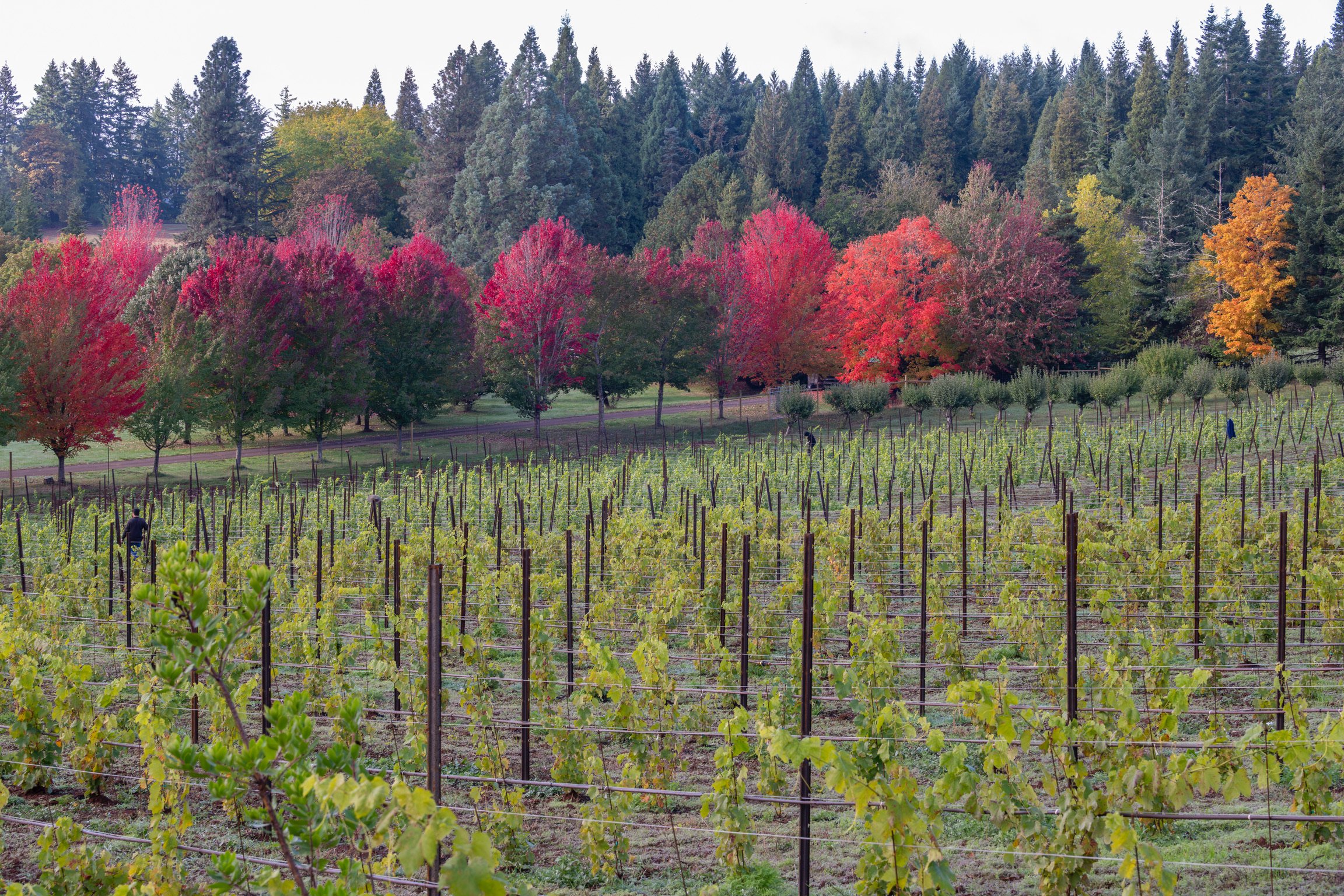
Most vineyards are built to quiet the world around them. A single species, repeated rows, the same human actions season after season: pruning, mowing, thinning, training, until the landscape becomes an authored script of symmetry and order. There is beauty in that clarity. Vineyards, at their best, can feel like architecture—an intentional shaping of land toward fruit, and fruit toward wine.
There is also a cost; the more we remove natural complexity from a natural place, the more we ask the farmer to supply what the natural system no longer provides. The flip side of single crop human-authored, ordered symmetry is that the plant becomes firmly dependent on the farmer to survive and thus farming becomes a battle to keep the crop supplied with enough fertilizers, agrochemicals, and other interventions to keep it alive in this simplified environment.
The Vitiforest began with a different curiosity. What if a vineyard were designed less as a controlled production surface and more as a habitat—an orchard of relationships, a living edge? Not a return to wilderness, and not a rejection of craft, but an experiment in what becomes possible when vines are allowed to grow with companions rather than alone.
Grapevines, after all, did not originate in monoculture. In their older life, they climbed and threaded through the complexity of forest margins, thickets, and river corridors, sharing light and water and space with trees and shrubs, fungi and insects, birds and grazing animals. Modern viticulture asks vines to perform with human support under simplified austerity. The Vitiforest asks vines what they might express, and what health they might sustain, if they were given a broader natural toolkit.
On an eight-acre parcel at Acania, established in 2025 on the footprint of a struggling apple orchard, we are co-planting grapevines with a broad palette of trees, shrubs, and perennial understory plants. Mulberries and persimmons. Serviceberries, aronia berries, huckleberries. Sichuan pepper, and many others—species chosen not as decoration, but as participants.
Their roots explore different depths. Their leaves cast different shades. Their flowers call different insects. Their litter becomes different food for soil microbes. Together, they create a layered canopy and root system that reshapes microclimate, insect habitat, and nutrient cycling.
This is not a finished design. It is a planting that will mature slowly, and it will not mature on a linear path. Some species will thrive. Some will falter. The balance between them will shift with drought years, wet springs, late frosts, heat spikes, pest cycles. Each season will write its own edits into the composition.
We are less interested in enforcing a fixed picture than in learning how a diverse community organizes itself over time, and how that organization changes the conditions in which vines live.
For now, it is an experiment in companionship—an eight acre place where vine rows do not stand alone, where the vineyard is allowed to have neighbors, and where the future of farming is approached the way good wine is approached: with rigor, humility, and an openness to what emerges.